Core Concepts
Frame, Scan, Proposal
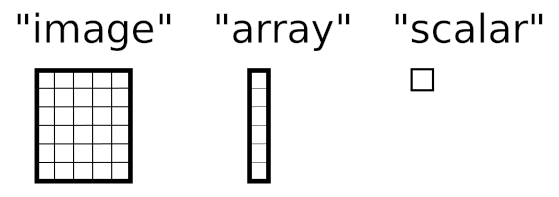
Nx5d expects its input data as N-dimensional arrays which have their 1st dimension as a raveled index for the current measurement frame (the "current data point").
The assumption that data dimensions of arrays are stacked "from slow to fast" is quite a general one. It is compatible with many scientific data standards, including the Nexus format. Nx5d is happy enough with a softer version: it requires only that the outer dimension of every scan be the one that entails data frames in the order they were measured.
The terms "frame", "scan" and "proposal" are at the core of Nx5d's data model. While the typical scientist will most likely have heard or used a variation of these, it is essential to unambiguously define them.
Frame: the (complete) result of one measurement step
When one is performing measurements as a physicist, not only the actual result like detector values matters. Additional data, e.g. positioner motor values, temperatures, various voltages, flow amounts etc, are also essential.
The complete set of values belonging to one measurement is called a frame in Nx5d.
Scan: a systematic series of frames
Typical measurements are performed by varying positioning parameters (e.g. angles, temperatures, delay times, voltages...) in a systematic, N-dimensional way, and recording a frame at every point of that variation.
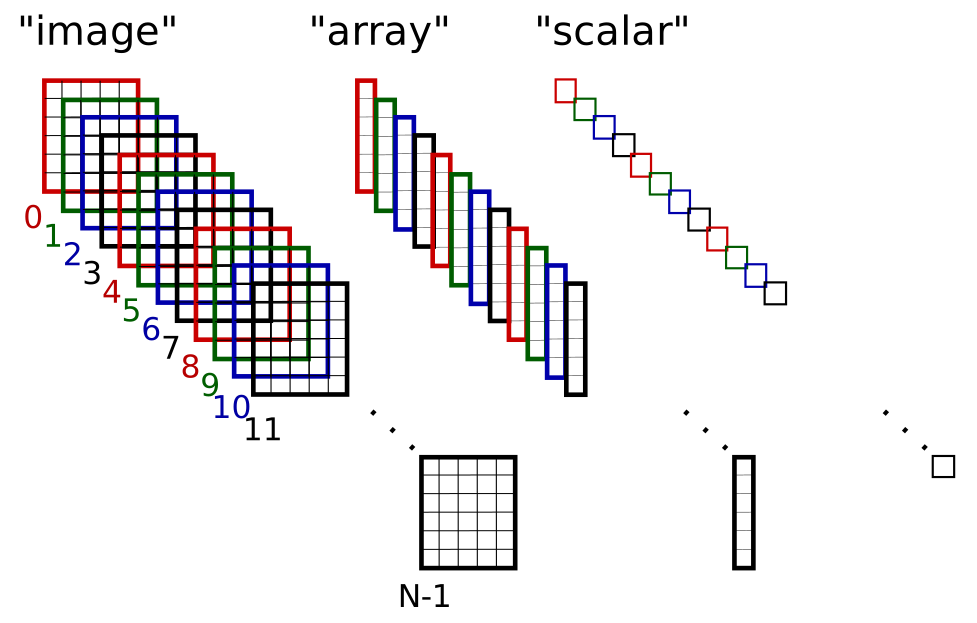
A scan is such collection of frames, bound together by the scope of a specific trajectory through the parameter space. It is thus a list of frames, i.e. a 1-dimensional collection, if viewed through an engineer's glasses. But to a physicist, a scan can be N-dimensional -- for instance if various positioners are "scanned" in a rasterizing manner across the parameter space.
Nx5d expects to ingest its data in an engineer's view: as a bunch of arrays with a 1-st dimension that needs to be collapsed (flattened) with respect to the scanning through the parameter space, if the scan was multi-dimensional.
Within a scan, every frame has an integer index, beginning with 0 and increasing strictly by 1, up to N-1 (with the total number of frames being N).
Proposal: collection of scans bound by scientific scope
A collection of scans is called a proposal in Nx5d.
The term "proposal" typically implies a specific scientific case, or an organisation of data tied by topic requirements. Often measurements are being performed within a limited time, e.g. the few days of "beamtime". How many scans make up a proposal is application dependent, but several hundreds is typical for X-ray diffraction.
With respect to the technical internals of Nx5d, we impose no such restriction on a proposal's scope. But keeping to the smallest useful scientific case simply is good scientific practice, and with Nx5d being all about the efficient management of proposal-level metadata, this common practice is highly encouraged.
Other terms you might encounter for bunching scans together could be "projects" or "sessions". However, the term "project" suggets a much broader scope (possibly spanning months or years of research). This can lead to confusion, as managing projects isn't primarily Nx5d's primary usage scenario.
Within a proposal, every scan has an ID. The ID can be numerical or string-based, but when all IDs of a proposal are sorted, their order must represent the chronological order in which they were collected. For example, timestamps or incrementing integers are valid scan IDs for Nx5d; UUIDs are not.
The Processing Model
Proposal Scoped, Scan Based
The proposal structure needs to be acknowledged when developing analysis automation. Although Nx5d focuses on scan based processing, it is designed to manage processing metadata on a proposal scoped level.
A proposal may contain a large number of scans. However, not every one is unique: they come in clusters where subsequent scans are of similar type. The number of fundamentally different scans in a proposal, i.e. differing in type, is typically in the single-digit range.
To illustrate, below is an excerpt from the structure of a real-life proposal, encompassing a total of 465 scans, in various clusters:
| scan | type | t | no. frames | notes |
|---|---|---|---|---|
| ... | ||||
| r0002 | alignment | 1 | 200 | dly3=[0, 700] |
| ... | ||||
| r0005 | alignment | 1 | 20 | x=[1, 11] |
| r0006 | alignment | 1 | 20 | z=[1.9, 3.9] |
| ... | ... | ... | ... | ... |
| r0070 | sRSM | 1 | 150 | th=[53.3695, 58.3695] tth=[101.5, 111.5] |
| r0071 | sRSM | 1 | 150 | th=[53.3695, 58.3695] tth=[101.5, 111.5] |
| r0072 | sRSM | 1 | 150 | th=[53.3695, 58.3695] tth=[101.5, 111.5] |
| r0073 | sRSM | 1 | 150 | th=[53.3695, 58.3695] tth=[101.5, 111.5] |
| r0074 | sRSM | 1 | 150 | th=[53.3695, 58.3695] tth=[101.5, 111.5] |
| r0075 | sRSM | 1 | 150 | th=[53.3695, 58.3695] tth=[101.5, 111.5] |
| r0076 | sRSM | 1 | 150 | th=[53.3695, 58.3695] tth=[101.5, 111.5] |
| r0077 | rocking | 1 | 20 | range=[54.3695, 58.3695] |
| r0078 | rocking | 1 | 40 | range=[54.5695, 56.5695] |
| r0079 | rocking | 1 | 40 | range=[54.6195, 56.6195] |
| r0080 | alignment | 2 | 50 | dmf=[-2000, 2000] |
| ... | ||||
| r0127 | sRSM | 40 | 40 | th=[52.75, 54.75] tth=[105.7, 109.7] |
| r0128 | sRSM | 40 | 40 | th=[52.75, 54.75] tth=[105.7, 109.7] |
| r0129 | sRSM | 40 | 40 | th=[52.75, 54.75] tth=[105.7, 109.7] |
| r0130 | sRSM | 40 | 40 | th=[52.75, 54.75] tth=[105.7, 109.7] |
| ... | ... | ... | ... | ... |
Two-Step Processing
We split the data processing in two distinct steps: cooking and analyzing.
Cooking is the transformation of raw data into cooked data. The main difference from raw is that it's represented application's natural coordinate system. Such a transformation is primarily an engineering task, requiring no scientific context.
Analyzing, on the other hand, is the process of gaining scientific insight. This is, in contrast, heavily tied to a scientific context, and is an operation for which raw data is utterly inadequate.
The boundary between the two processing steps is the decision boundary. This is because cooking data requires virtually no human decision-making ("A well-trained monkey could do it!" - cheeky Nx5d devs). Meanwhile analyzing is all about scientific decisions.
This doesn't imply that cooking is easier or simpler, often quite to the contrary. But it's a more rewarding target for automation than analyzing.
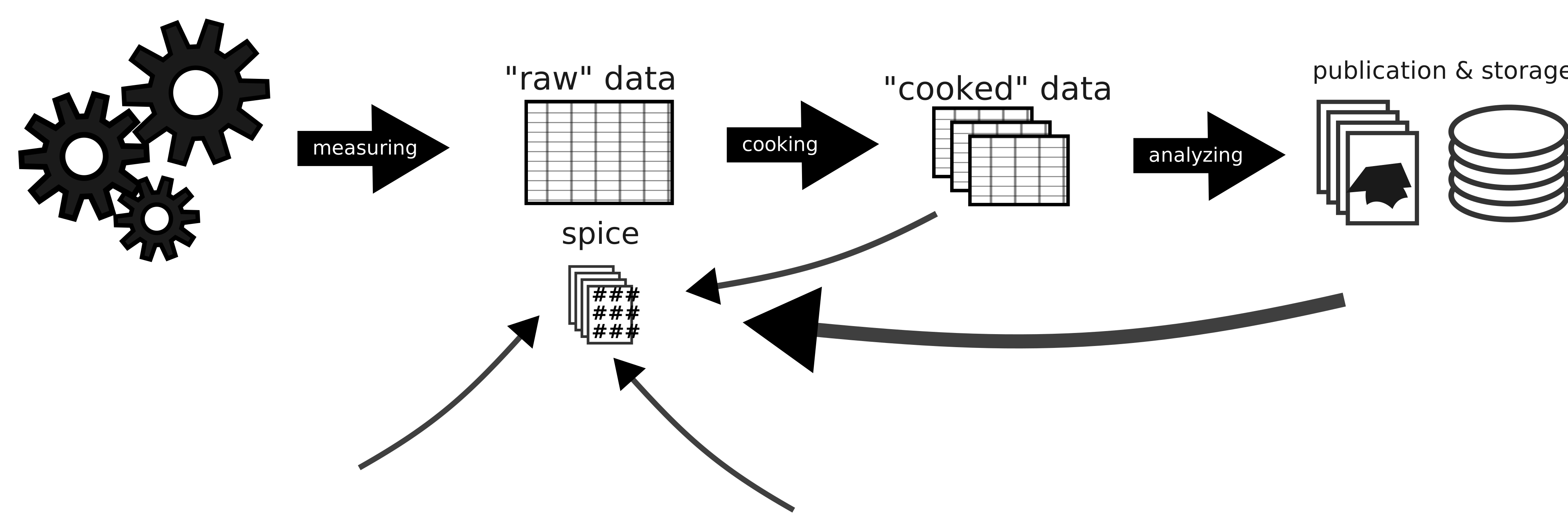
The main difficulty is that processing data is not a linear process. Strictly one-way pipelines of the form "measure -> cook -> analyze" are unicorns. More commonly, processing requires at least some degree of individually adjusted, case-specific processing metadata. As illustrated below, sometimes that metadata is also a product of a later processing step -- be it for reaasons intrinsical to the experiment, or just out of engineering limitations of the day:
The Spice Concept
Spice Data Model
This kind of metadata, that is necessary for cooking but subject to non-linear workflows, is what we call spice. It is organized as a list of key-value pairs where the keys are all strings, and the values are JSON compatible data -- i.e. scalars, arrays, objects, all of these possibly nested. In the context of a proposal, spice keys are clustered together in spice types, i.e. sets of object (or "dictionaries") with a given name.
Examples of such metadata include: offset corrections, initial parameters for fits, boundaries for data filtering; but also purely algorithmic settings like grid sizes and resolutions, reduction strategies etc.
To convey an idea, here are two example types for spice at the BESSY-II KMC3-XPP beamline:
-
exp_info, describing the experimental X-ray diffraction geometry in an algorithm-agnostic way:{ "goniometerAxes": {"theta": "y-", "chi": "x+", "phi": "z+"}, "detectorAxes": {"tth": "y-"}, "detectorTARAlign": [0.0, 0.0, 0.0], "imageAxes": ["y+", "z-"], "imageSize": [195, 487], "imageCenter": [95, 244], "imageDistance": 481.0, "imageChannelSize": [0.172, 0.172], "sampleFaceUp": "z+", "beamDirection": [1, 0, 0], "sampleNormal": [0, 0, 1], "beamEnergy": 10000.0, } -
offsets, supplying additional corrections for the angles Chi, Phi, Theta and Omega (respectively 2-Theta):
Adequate management of spice, its defaults, and resulting values for a particular scan, is crucial. This is the central point of Nx5d's iterative data processing model.
Editing Spice
There are several operations that we define for spice:
-
Seeding is introducing a spice type to a proposal. After seeding, a spice type is available with its default seed values for every scan.
-
Viewing is retrieving spice values with respect to a view point, i.e. a scan ID. For a freshly seeded spice type, all view points will yield the same value, but anchoring (see below) alters this behavior.
-
Anchoring (also called branching) is creating an anchor point at a specific scan ID, i.e. a permanent boundary for the propagation of updates to a spice type (see below).
-
Updating is changing a spice value. Updates are always specified with respect to a view point, and propagate only between two adjacent anchor points -- or the corresponding boundary of the scan list in either direction, if no limiting anchor point is encountered.
Every spice operation is timeless with respect to the raw data: i.e. it takes effect retroactively, for all scans of a proposal, future and past. This means that, once a spice operation has been performed, processing steps (in particular cooking) performed in the past need to be performed again.
To illustrate, for the earlier proposal example the full spice database with anchor points looks like the following table:
| anchor | offsets |
exp_info |
|---|---|---|
| initial: phi=0 chi=0 theta=0 tth=0 | initial: (values suppressed) | |
| r0043 | beamEnergy=10207 | |
| r0047 | beamEnergy=10000 | |
| r0058 | beamEnergy=6800 | |
| r0118 | theta=30 | beamEnergy=10207 |
| r0120 | theta=1.5 | |
| r0164 | beamEnergy=6800 | |
| r0226 | beamEnergy=10207 | |
| r0238 | beamEnergy=13614 | |
| r0279 | beamEnergy=10000 | |
| r0412 | beamEnergy=10207 | |
| r0431 | beamEnergy=13614 |
Here we see the initial seeding of both types, then two subsequent anchor
points and updates (r0118 and r0120) for offsets, and 10 anchor points
with modification to its "beamEnergy" parameter for exp_info.
This allows to address a very large number of scans, while still permitting the propagation of specific settings to the exact scan they're required.
Recipes
With the parameter model in place, the final step is actual data processing: creating of cooking algorithms. To use the food metaphor one last time, we call such algorithms recipes.
Every scan type of a proposal is mapped to a processing recipe. The specifics of how this is done are left to the specific Nx5d backend. But now that we have a proposal-scoped mechanism for settings management, using it to define which algorith to use for cooking of which scan type is encouraged, and is the default for backends shipped natively with Nx5d.
In A Nutshell
The Nx5d proposal model is shown "in a nutshell" in the image below. The essential features shown are:
- the data is a collection of scans
- each scan has a specific collection of frames
- the exact structure of the frames (which arrays / dimensions) may differ from scan to scan, but are largely repetitive
- additional data, spice, is made available alongside scans
- each spice type in itself varies on a relatively slow scale
- eacn scan has access to a well-defined, but individual "view" of a spice blend, required for further processing.
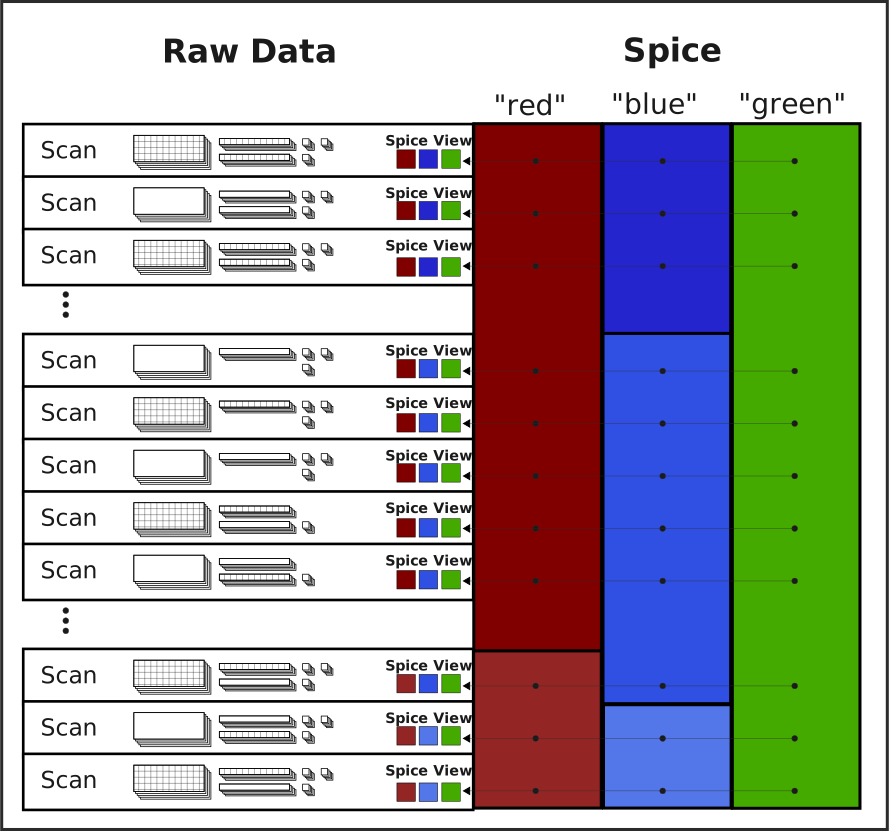
This is how, at its core, Nx5d is an engine for management and propagation of scan-level settings, through an elaborate system of proposal-level fallback mechanisms.